
The second edition shows SMBs how to attract talent, win customers, and command pricing power.
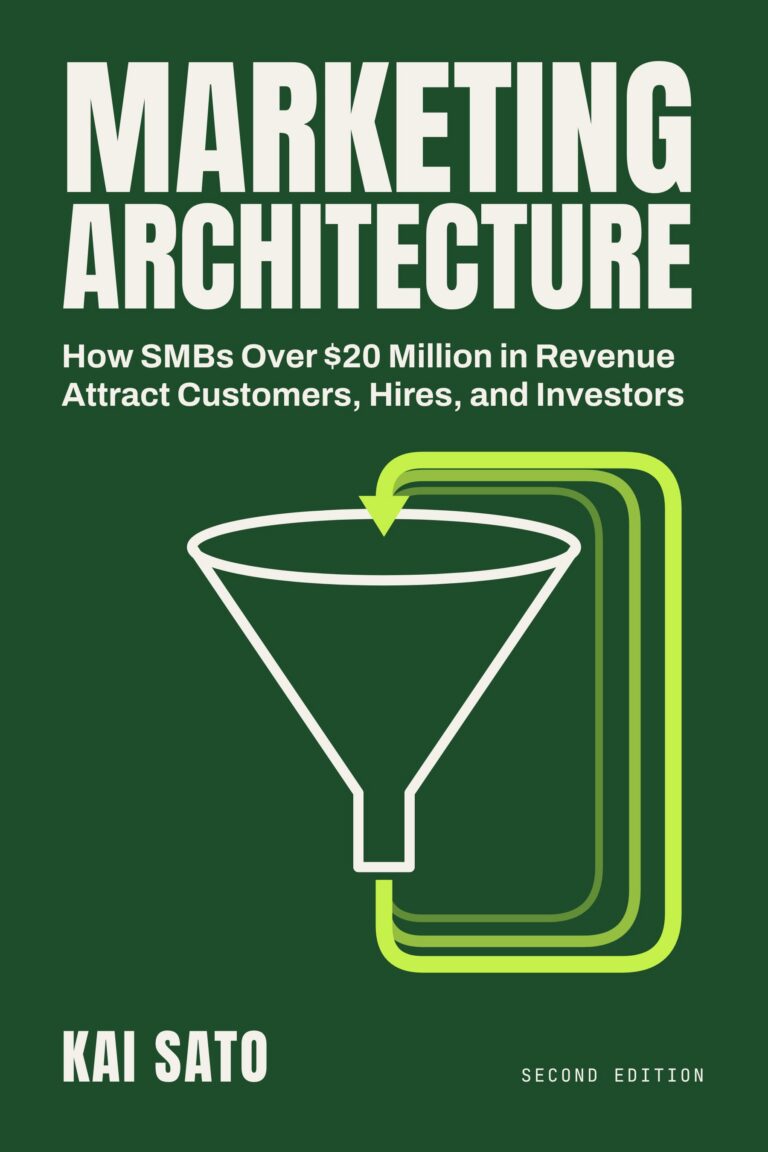
WASHINGTON, D.C., November 12, 2026 – The second edition of Marketing Architecture: How SMBs Over $20 Million in Revenue Attract Customers, Hires, and Investors, by Mauloa Managing Partner Kai Sato, is available now in paperback and Kindle editions on Amazon.
The book addresses a problem most owners already recognize. They know their marketing could be better. What they don’t know is where to start, and the cost of waiting compounds quietly. It shows up in hiring, where the best candidates take jobs at the companies that recruited them better. It shows up in price, because when two companies do comparable work, the one people have heard of wins the job and charges more for it. And it shows up the day someone values the business, because almost nobody pays a premium for a company they haven’t heard of.
The Firm Had the Problem First
Mauloa is the book’s primary case study, and early on, not a flattering one. For years the firm stayed deliberately quiet, to its own detriment.
There are more than 2.3 million boomer-led businesses in the United States and no shortage of middle-market capital chasing them. Supply was never the constraint. Demand for Mauloa specifically was: owners who want to keep building without selling out, and who know the firm exists.
Nothing about the offer changed. Mauloa articulated it better, made itself easier to find, and focused on specific markets and verticals. What that produced is proprietary deal flow.
Marketing Architecture opened my eyes and completely changed the way I think about companies. For years, we deliberately flew under the radar, and we paid for it in missed opportunities. Marketing Architecture is doctrine at Mauloa: we practice everything in this book, and we apply it across our portfolio companies. Quite simply, the most successful companies tend to be the ones that embrace it.
Andrew Sachs, Founding Partner, Mauloa
In the Portfolio
The framework is much of what the firm brings after it invests. O’Connor Plumbing, a third-generation family business and Mauloa’s first Fund III investment, had no formal marketing department. Co-owner Kevin O’Connor later told WTOP that the company grew a little over twenty percent with Mauloa’s help, then repeated it the following year. Marketing Architecture has also helped O’Connor land key executive hires, who have in turn hired 10 new plumbers in less than two months.
Mauloa’s refreshing approach to growth capital allows us to maintain control of the company while leveraging their operational expertise and formidable network, in order to make a great community business even better.
Kevin O’Connor, co-owner, O’Connor Plumbing
In the Accelerator
The same framework anchors the curriculum of the Mauloa SMB Accelerator, now in its second cohort with three Washington-area companies: Strategic Factory, AceCo, and Got Electric. Each company selects a single area of focus, usually talent or customer acquisition.
Six weeks into the program, Got Electric wrote publicly that the process gave the company “a valuable reason to step back and look at the business as a whole.” With announcements forthcoming, the company is pursuing a growth strategy that expands its services across the DMV and into other key markets around the country.
Strategic Factory, meanwhile, is sharpening the messaging of its fast-growing signage business, which already works with the Baltimore Ravens, Washington Commanders, Jacksonville Jaguars, and a number of large general contractors.
What Is in the Book
Marketing Architecture is built around CHI: a company’s ability to attract Customers, Hires, and Investors. Marketing is not one department’s job, and it is not social media or press. It is everything that moves the right people through three funnels, sales, recruiting, and investor, and turns them into evangelists on the other side.
The work divides into a Foundation of Brand, Website, and Product, the three things an owner controls completely, and nine Levers that compound when pulled in order and waste money when they are not. All of it serves word-of-mouth, the only marketing outcome that cannot be manufactured. Every chapter ends with a scoring section that builds to the MarkArc Score, a twenty-five-point scale the whole company can follow, and an AI section, because work that once required a ten-person marketing department can now be done by one person with the right tools.

It is written for family-owned companies north of $20 million in revenue, usually without a formal marketing department. There, marketing gets run by committee. Nobody owns it, everybody agrees it needs work, and it drifts for years. Then someone steps up. Sometimes it’s the CEO with a sale on the horizon. Sometimes it’s a family member, or a CFO who wants to compete for talent on LinkedIn and has the discipline to follow through. Often it’s whoever was standing closest when the job needed a home: a business development manager, an operations lead, anyone willing to raise a hand. They have usually hired consultants and have little to show for it. What they need is not another vendor. They need a bridge.

Build it and the compounding runs the other way. The best candidates apply without being chased. Customers arrive pre-sold and refer the next ones. Capital comes looking. Word-of-mouth does the work, and the business is worth more on any day someone decides to measure it.
Marketing Architecture has reshaped our investment firm because Andrew Sachs leads by example, which is what we ask of our portfolio companies as well. The framework has created value at our companies and led to proprietary deal flow for Mauloa. We hear from more like-minded business owners than ever: people with great cultures who are building for the long term and want to scale from $20 million in revenue to $50 million and beyond.
Kai Sato, Managing Partner, Mauloa
Marketing Architecture, Second Edition, is available in paperback and Kindle editions on Amazon.